Memory Journaling for Busy Moms: Preserving Your Story, Not Just Theirs
By Christy R. Burger
This post may contain affiliate links. This means I may earn a small commission at no extra cost to you if you make a purchase through my links.
Many moms lovingly create baby books and family scrapbooks filled with birthdays, vacations, and milestones. But how often do we pause to document our own stories, the stories that reveal who we were before motherhood, who we are becoming, and what we truly value?
Memory journaling offers a simple, meaningful way to preserve those personal stories while creating a keepsake your children will someday treasure.
What Is Memory Journaling?
Memory journaling is the practice of writing down the memories, moments, and stories that matter most to you.
It can capture everyday life, family relationships, personal growth, and the experiences that shaped you long before you became a mom. It can even help you document the woman you hope to become.
5 Reasons to Begin Memory Journaling
You might be wondering if memory journaling is really worth adding to your already busy schedule. The truth is, it can be one of the simplest and most meaningful habits you create. Here are five reasons to begin.
Your stories deserve to be told from your own perspective.
Your memories are shaped by your past experiences, surroundings, emotions, and even your age. They are personal and uniquely your own. You are the only qualified author of your stories.
It preserves the stories that photos cannot.
Photos capture people, places, and moments, but journaling reveals the emotions, lessons, and meaning behind them. A photo cannot share the love you felt when holding your newborn or the excitement that kept you awake as a child on Christmas Eve. Those stories live on only when you write them down.
It creates space for self-reflection.
Journaling helps you reconnect with your identity beyond daily responsibilities. Motherhood is a full time, lifelong role, and the weight of it can leave little room to dream about your own future. Journaling gives you space to reflect on who you are becoming and what you want for your life.
A Memory Journal becomes a cherished keepsake.
Your children will treasure the chance to know you more deeply as they grow. Imagine being able to share what you experienced, felt, and learned before and during motherhood with your adult children. Your journal could become the reassurance or wisdom they need when they become parents.
It only takes ten minutes a day.
A memory journal does not require hours of writing. Small, consistent moments add up. Just a few sentences can capture important details that help record your past, present or future. Setting aside ten minutes a day benefits you and your family.

Supplies Needed for Memory Journaling
Once you’re ready to start capturing your stories, having the right supplies can make the process feel more inviting and meaningful.
Only two items are needed to begin memory journaling: a pen and paper. However, investing in a quality journal can make the experience more enjoyable and provides a dedicated place to gather your thoughts. Below are a few recommendations for journaling supplies that work well for beginners and seasoned writers alike.
As an Amazon Associate, I earn from qualifying purchases.
Journals
Leuchtturm1917 120G Special Edition Notebooks with dot grid pages are my personal favorite. Blank and ruled versions are also available if you prefer a different layout.
The chamois‑colored paper, a soft light cream, is easier on the eyes and provides a smooth writing surface. The 120 gsm paper is heavier than that used in the Leuchtturm1917 Classic Notebooks. This heavier paper is fountain‑pen friendly with no bleed through.
The Medium A5 size (5.75” x 8.25”) is compact and easy to carry while the elastic band closure keeps your journal secure when it is tucked into a bag or backpack.
Each notebook includes 203 numbered pages and a blank table of contents. The numbered pages make it simple to index your entries so you can find them quickly without flipping through the entire journal.
Pens
A nice journal deserves a nice pen, and the PILOT Metropolitan Collection Fountain Penoffers a smooth and enjoyable writing experience.
It is a mid‑range fountain pen in terms of price, and the convenience of disposable ink cartridgesmakes it especially appealing. Traveling with bottled ink for traditional fountain pen refills can feel intimidating, so the cartridge system is a practical alternative.
How to Begin Memory Journaling
Now that you have your supplies, the next step is deciding what to write about and how to begin.
I understand that you are busy, and choosing what to write each week can feel like one more task on an already full list. You probably have many memories you want to share, but it can be hard to know which ones to document first.
My Memory Mapis an exercise that helps you list your memories by the decades of your life. It also encourages you to think about future memories you would like to capture.
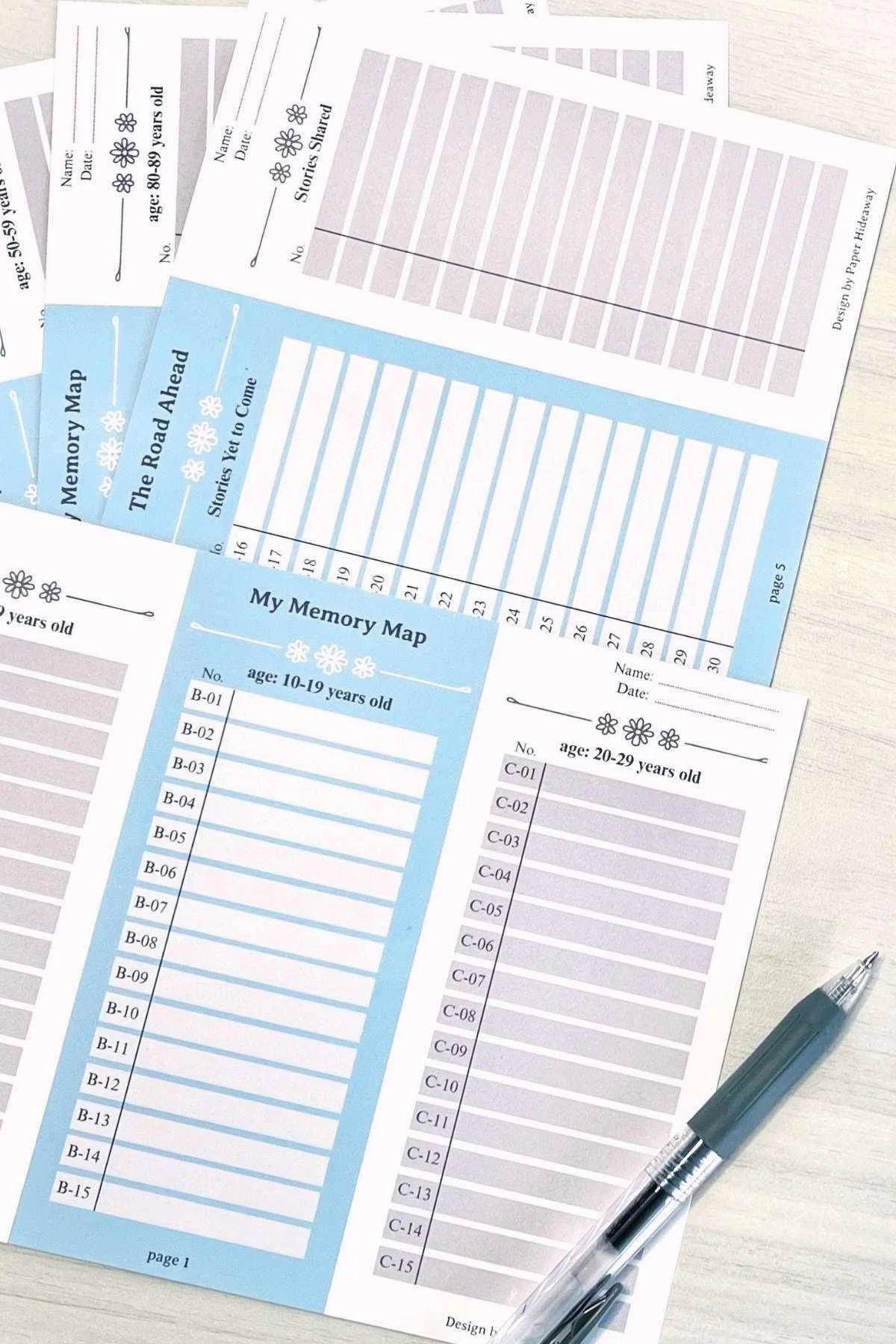
This exercisetakes about 30 minutes to complete and helps you identify the top ten stories you want to focus on right now. It also gives you a long list of additional stories you can return to in the future.
Once you have your top ten list, you may wonder how to write an entire story when you only have ten minutes a day. Try answering the 5 W’s:
Who? Identify the people involved, using first and last names.
What? Share the important facts.
When? Provide a date. An approximate date is better than none.
Where? Describe the location.
Why? Explain what makes this story meaningful to you.
Tackle one or two W’s a day until your story feels complete.
Also, neat pages or perfect entries should not be the goal. Your journal is meant to be used, not preserved in its untouched state. It is simply a place to gather the small details that make your memories your own.
Some days your writing may take the form of a list. Other days you may write a few paragraphs. For now, focus on documenting your top ten stories in whatever written format feels manageable.
If you dislike your handwriting, you can type your stories. However, nothing beats the convenience of a journal and pen. Tuck them into your bag, and when you are waiting in the car rider line or enjoying a brief moment alone, jot down a few thoughts. These small pockets of time can add up quickly for a busy mom.
Creating a Keepsake that Lasts Beyond the Busy Years
Congratulations. You are on your way to creating a keepsake your family will cherish for years to come.
Once your top ten stories are documented in your Memory Journal, you may want to explore other ways to preserve them. You might choose to pair your stories with photos or even record a video of yourself reading them aloud. My post How to Begin Documenting Your Life offers simple suggestions to help you preserve your story with intention.
Your days are full, but your story is worth the space it takes to write it down. One memory at a time, you are creating a legacy your family will treasure.
About The Author

Hello, I’m Christy. I’m a mom, a memory keeper, and the creative hands behind Paper Hideaway. My goal is to provide simple and inspiring ways to help you document, share, and preserve your memories.
If you are not quite sure where to begin with memory keeping, Paper Hideaway is here to guide you. It is not about recording every moment of your life. Instead, it is about reflecting on the stories you value most and preserving them for future generations.
You can connect with Christy here:
Website: https://paperhideaway.com
Instagram: @paperhideaway
Pinterest: @paperhideaway
Note from Our Little Peas
If this message resonated with you, and you’re wanting simple, meaningful ways to live this out with your child.
That’s exactly why I created The Learning Pod.
It’s designed to help you connect with your child through play in a way that feels doable, not overwhelming—so you can be present in your days without feeling like you have to figure everything out on your own.
→ You can learn more about The Learning Pod here.