Developmental Readiness + Differentiation
The Learning Foundations Series | Part 3
In the last post of The Learning Foundations Series, we explored learning styles and how kids absorb information differently. Today we’re taking the next step and talking about readiness, because even the “right” activity can fall apart if the timing isn’t right.
In this series:
The Secret to Passionate, Lifelong Learners (Learning Foundations)
Meet Them Where They Are (You are here)
One day your child can do something completely on their own.
The next day, they can’t (even though you know they’re capable!)
This isn’t regression, laziness, or lack of learning.
It’s developmental readiness.
When Learning Doesn’t Go the Way You Planned
Most of us carry memories of schoolwork that didn’t quite click. Not because we couldn’t learn, but because the learning didn’t meet us where we were at the time. Maybe the timing was off, or the approach didn’t match how we naturally processed information.
(If you’d like to explore how learning styles shape the way children process information, I share more about why they matter here)
Or maybe you’ve tried an activity at home with your children and it was a complete flop.
You sit down with the activity you planned. It looked simple. Educational. Maybe even fun. But within minutes, your child is distracted, frustrated, or melting down, and you’re left wondering how something meant to help turned into such a mess.
You might throw in the towel and give up too. Maybe you even convince yourself that you’re just not meant to teach, even though you’ve been teaching your child since day one.
Knowing when to pause is just as important as knowing what to teach.
Often, what looks like resistance or lack of interest is simply a sign that the activity did not meet your child where they were emotionally, developmentally, or energetically that day. When expectations do not align with readiness, frustration shows up quickly for both kids and parents.
And when that happens, many parents carry the weight of it long after the activity is over.
The worry.
The guilt.
The feeling that you should be doing more.
This post is here to gently remind you that your child is not the problem. The task just was not the right fit yet.
Sometimes this happens because of how an activity is presented, and other times because it is not personalized enough for your child’s readiness.
When we talk about developmental readiness, it can sound technical or intimidating. But readiness is not a checklist or a milestone chart.
It is simply a way of noticing what your child is capable of handling right now.
Readiness is not about age.
It is about capacity.
A child can understand a concept and still struggle to engage with it if they are tired, overstimulated, hungry, or emotionally dysregulated. That does not mean the learning is too advanced. It means the moment is not right.
Readiness shifts from day to day and even hour to hour, especially in young children.
New here? Start from the beginning → The Secret to Passionate, Lifelong Learners
Why Readiness Changes From Day to Day
This is why learning can look different from one day to the next. A child who happily counted yesterday might refuse today. A child who loved an activity last week might avoid it now. That does not mean progress is lost. It means readiness is fluid.
A child can be capable of learning something and still not be ready to practice it yet. Readiness depends on so many factors, including energy, emotions, and how much their brain is already carrying that day.
Sometimes meeting your child where they are means simplifying the activity because it feels too tricky at that moment. Other times, a child with a busy heart may need the learning broken into smaller pieces. Sometimes it is both.
In education, we often describe this as scaffolding. It simply means offering more support at the beginning and slowly pulling back as confidence and understanding grow.
I like to think of it like learning a new recipe. The first time we make something, we move slowly and reread the steps to make sure nothing is missed. After practicing it a few times, we barely need the recipe at all and might even add our own twist.
Learning works the same way. Everyone needs different levels of support depending on the skill, the moment, and their interests. We accomplish this using developmentally appropriate learning activities.
That support is not a setback.
It is a normal and necessary part of learning, especially in the beginning.
4 Ways Readiness Shows Up in Real Life
Developmental readiness is not one single thing. It shows up through a few key signals that are easy to miss when we are focused on the activity instead of the child.
Emotional Readiness
Gosh, this one hits home whenever I am trying to ask my daughter to do something right before bed, even if it is something as simple as putting her toys away. Okay, maybe that is not such a simple task in our house. Emotions control so much of our lives, including our readiness to learn.
This is not just about big, hard emotions. Sometimes we have to consider the extra positive ones too, like intense excitement or being overly silly. Those moments are beautiful, but they are not always the best time for focused learning.
A calm body learns more than a compliant one.
Attention Span
Do your children spend a long time with one single toy? Even if it is their favorite, they are still likely to move on fairly quickly or add something else into the mix. When it comes to learning and introducing something brand new, it helps to expect an even shorter attention span for our littles.
A few focused minutes can be far more meaningful than a long, forced activity.
Every child learns differently. If you have a child who loves to move, they will likely need movement built into their learning or regular movement breaks. Breaks are important for all children. They give the brain time to pause and process what it just absorbed without going into overdrive. It is often better to stop early than to push beyond their limits.
Sensory Needs
Using our senses can do incredible things for learning. Sensory experiences help ideas connect and stick in the brain in a deeper way. Think about it. If you were learning about beavers, being able to hold one would completely change your understanding. You would notice texture, movement, sound, and color all at once.
When children learn through real life experiences, their understanding goes much deeper than when they are simply told about something. This is why play-based and hands-on learning is so powerful for young children.
Motor Skills
When it comes to motor skills, it helps to think about what your child is truly ready for developmentally.
Before a child can write letters, their hands need strength, control, endurance, and coordination.
Those skills do not appear overnight.
They grow through repeated practice in playful, hands-on ways.
I saw this firsthand when teaching my daughter how to put on socks.
Instead of asking her to put on her own socks right away, we started with mine. They were much larger, which made the movements easier and allowed her to focus on the process without frustration.
What felt like a slower approach actually helped her learn faster.
Motor skills include both gross motor skills, like climbing and jumping, and fine motor skills, like grasping and controlling small movements.
Many of the activities that build these skills do not look academic at all. Everyday play and hands on tasks are doing important work behind the scenes.
Progress will not always look even or linear, and that is exactly how development is meant to unfold.
This is a perfect example of how, in learning, going slow often helps us go fast.
How To Actually Meet Your Kids Where They Are
So how do we actually meet kids where they are in real life?
Incorporate Unconventional Learning
One of the most effective ways to meet your kids where they’re at is by incorporating unconventional learning experiences that work with their development, not against it.
This doesn’t mean lowering expectations or abandoning goals.
It means changing the path, not the destination.
When learning meets children in ways that feel engaging, sensory, and doable for their bodies and brains, everything shifts.
Early learning through play.
Here are two simple examples of what that can look like.
Shaving Cream to the Rescue
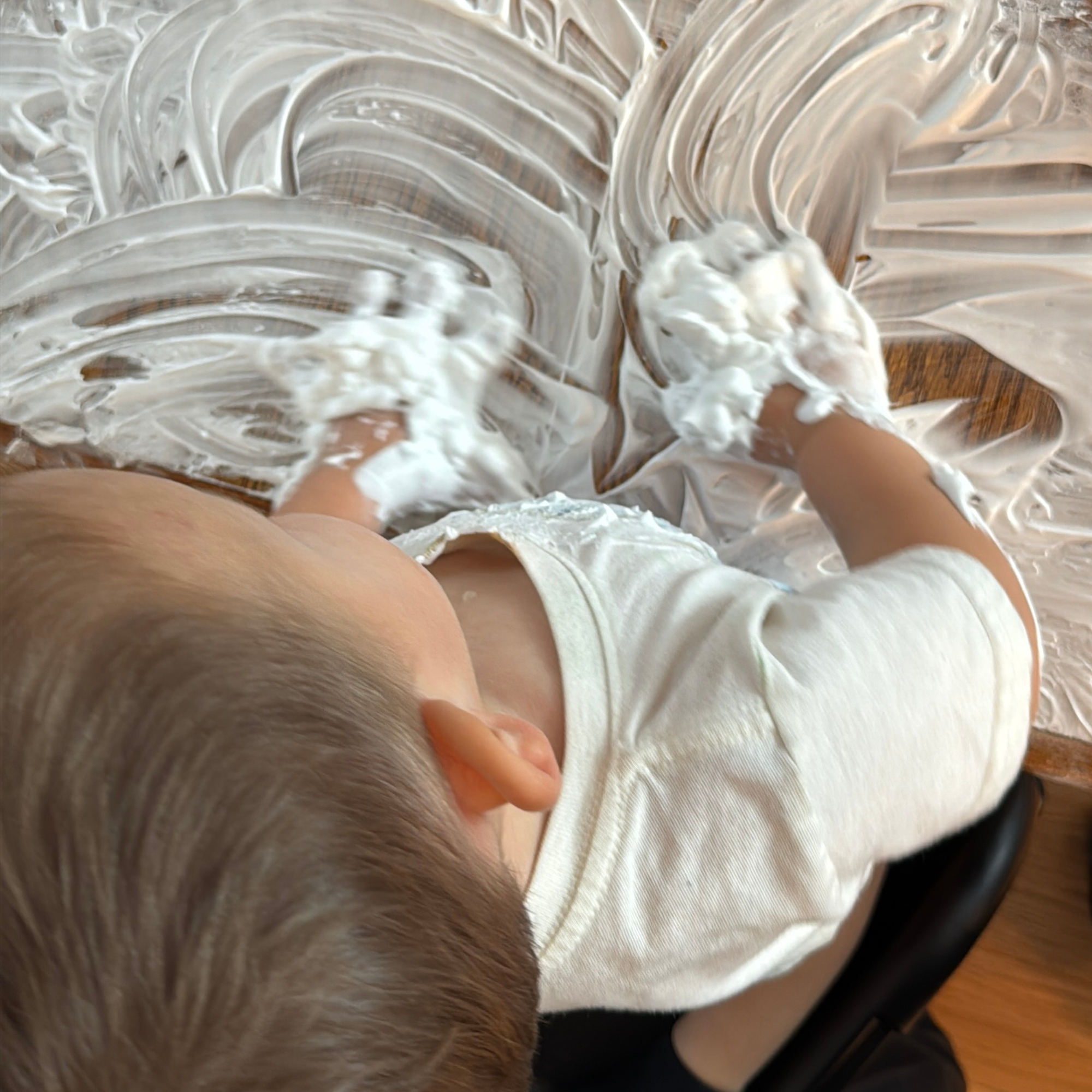
Shaving cream parties are my kids’ favorite things to do! It also makes your table SPARKLE!
Like many of us, I grew up thinking that writing only counted if it happened on paper with a pencil. So when it was time to practice letters with my daughter, that is exactly where I started. We sat down at the kitchen table with a notebook and pencil, and I planned to demonstrate a few letters together.
But almost immediately, the pencil became the problem. Even though I knew she was capable of forming the letters, holding and controlling the pencil was too much all at once. Frustration set in quickly.
So, I changed the path, not the goal.
I ran upstairs, grabbed my husband’s shaving cream, and brought it to the table. When I sprayed it out, my daughter looked at me like I had completely lost my mind.
But when I put my hands in the shaving cream and started spreading it across the table, something shifted.
She laughed. And then she joined in.
We practiced the same letters, but this time with our fingers in the shaving cream. No pressure. No tears. Just learning that felt doable again. Yes, it was a little messy, but it worked. And bonus, the table sparkled afterward.
The goal never changed. We were still practicing letters. We just met her where she was that day.
Blueberries, Multipurposed

Learning is truly in EVERYTHING we do!
I think many of us have experienced something similar. When I began working on counting with my daughter, I had planned out a full lesson using cards. It quickly turned into a disaster. She was not interested at all, and because the concept and the method were both new to her, she was wiggly, silly, and clearly not in the mood.
Instead of completely tossing the lesson, I adjusted it. We still practiced counting, but it happened on her terms. At that moment, counting looked like counting the leftover blueberries on her breakfast plate. Same learning goal, a very different vibe, and it worked.
The learning goal didn’t change. The path did.
The Order That Changes Everything
Regulation first.
Connection second.
Learning third.
Learning cannot come first because a child who is overwhelmed, dysregulated, or disconnected does not have access to learning yet. Their brain is busy managing emotions or sensory input, not taking in new information.
That is why regulation comes first. When a child’s body feels calm and safe, connection becomes possible. And when a child feels connected, learning naturally follows.
Everything we have talked about so far fits into this order. When an activity falls apart, it is rarely because a child is not capable. More often, one of these steps was skipped. When we slow down and honor this sequence, learning becomes easier and more meaningful for everyone.
Releasing the Pressure to Push Academics
Our traditional way of learning does not have to be the only way we teach our children. Children do best when learning meets them where they are and honors what they are ready for in that moment.
Pushing past readiness often creates resistance. Supporting readiness, on the other hand, builds confidence, curiosity, and excitement in their little hearts. When we ease the pressure around academics and allow learning to feel more joyful and less rigid, something shifts for everyone.
Not only does learning become more enjoyable, but we also begin to nurture a genuine love for learning. And that love, more than any worksheet or milestone, is one of the greatest gifts we can give our children.
This is why understanding how children learn matters before we ever worry about what to teach.
Play-Based Resources and Support Inside the Learning Pod
Since teaching your kids at home can feel so complex, I’ve created various play-based resources and a membership so that you can feel confident doing so!
Each activity is designed with flexibility in mind, offering multiple ways to engage so families can choose what fits their child and their day. There is no single right way to complete an activity, because children do not all show up with the same readiness at the same time.
The membership goes beyond the activities themselves. It is meant to support parents too. Through simple, ready to use resources and a supportive community, families are encouraged to trust their instincts, share ideas, and feel less alone in the learning process.
The goal is not perfection or doing everything. It is confidence. Confidence in meeting your child where they are, knowing that learning can still happen in a way that feels connected, calm, and sustainable.
Overall, when we let readiness lead, something interesting happens. Play stops feeling like a break from learning and starts becoming the lesson itself.
What Comes Next
Next in The Learning Foundations Series → Play Is the Lesson, where we’ll talk about why play isn’t a break from learning, it’s one of the most powerful ways children actually learn.