Little Peas, Big Play: Transportation
A playful transportation exploration with books, videos, movement, and hands-on learning
What if learning didn’t feel like something you had to start over every day, but something your child kept thinking about long after you closed the book?
Why Transportation Sparks So Much Learning
Let’s dive into transportation. 🚙
If your kids are anything like mine, they’re naturally drawn to things that move, especially in our house where race cars are basically a way of life. Wheels rolling, planes flying, bikes racing, trucks delivering. Transportation is woven into their everyday world, both literally and through their imagination.
I swear my son will play with just about anything if it somehow involves a car or a truck. It’s how they explore, pretend, and make sense of what they see around them.
The most powerful learning happens when we bring it to where our children already are. From the moment they’re born, they show us how they learn best through play, curiosity, and connection. Just think about it.
They learned how to walk, talk, and build relationships without a single worksheet. Wild, right?
Real learning is so much bigger than traditional academics. It’s about movement, wonder, and discovery, all working together.
If you’re new to play-based learning, I break down what it really means (and why it works) in Play Is the Lesson.
Sensory Play
Airplane Adventures (Sensory Play)
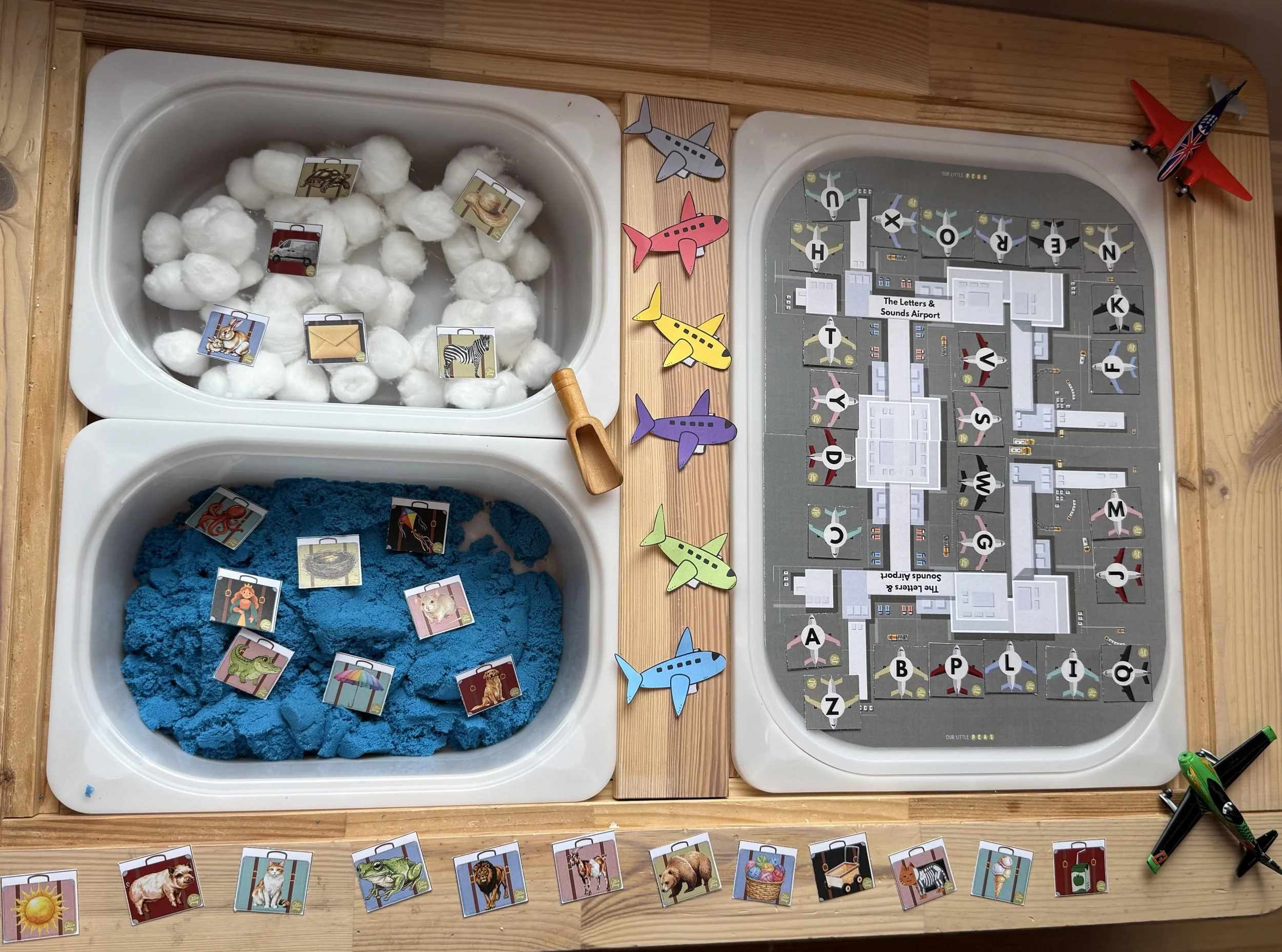
From Our Little Peas, The Learning Pod Membership - The Letters and Sounds Airport
Sensory play is one of the easiest ways to help kids stay focused and engaged while they learn. When children get to scoop, pour, and move things with their hands, it helps everything slow down and really stick. A transportation sensory setup gives them a simple way to explore this theme through hands-on play.
We especially love a pour-and-play setup using jars because it’s easy to reuse and switch up throughout the month. It gives kids something they can come back to again and again while they explore vehicles and how things move.
Inside our Transportation Unit, we also include a Letters & Sounds Airport activity that pairs well with sensory play, letting kids match letters and sounds as they play.
If you’d like to create your own airplane sensory bin, here are a few simple ideas:
blue rice or sand for the sky
We love Hands-On Sensory Play’s pre-made Airplane Sensory Rice Bin for an easy grab-and-go option.
small planes or printed paper airplanes
helicopters or anything that flies
white cotton balls or pom-poms for clouds
small cups or scoops for pouring
Storytime & Books
Stories help children make sense of the world, and transportation stories are especially powerful because they mirror what kids see every day.
When we read about vehicles, journeys, and helpers, children aren’t just learning facts, they’re building language, imagination, and confidence through story.
Books are where this transportation exploration really begins. Stories and pictures help kids make sense of how the world moves, from cars and trains to planes and boats.
We like to read one or two each day and then let the ideas from the stories spill into our play.
Our Transportation Bookshelf
These are our go-to books for building a strong foundation and really understanding how the world moves.
Transportation! How People Get Around by Gail Gibbons
This is a great place to start because it shows so many different ways we travel. The clear pictures and beautiful illustrations help even very young children understand cars, trucks, trains, planes, and boats in a way that feels easy and exciting.
Vehicles and Transportation by Benjamin Becue
A kid-friendly guide to just about every type of transportation, with simple explanations and side notes that show how each one works.
The Ultimate Book of Vehicles by Anne-Sophie Baumann
An interactive pop-up book that lets kids physically explore how different vehicles work, turning curiosity into hands-on understanding.
The Little Book of Transportation by Zack Bush & Laurie Friedman
A bright, engaging introduction to all kinds of transportation, from cars and trains to ships and planes. The simple language, colorful illustrations, and strong vocabulary support make it easy for kids to understand how people and goods move around the world.
Movement & Big Play
Movement is such a huge part of how our little ones learn. When kids get to move, run, spin, and zoom, their brains are way more engaged and everything just clicks a little easier.
With transportation exploration, movement lets them feel what it’s like to be a plane, a car, or a train instead of just hearing about it. It’s all about EXPERIENCING IT.
This is usually a child’s favorite part because it feels like play.
They’re running, stopping, pretending, and laughing, all while building coordination, body awareness, and confidence without even realizing it.
Here are a few fun ways to bring it to life:
Red Light, Green Light 🚦
One person is the “traffic light.” When you call out green light, everyone moves. When you say red light, everyone freezes. Add yellow light to move super slow for extra giggles.Stoplight bean bag toss 🚥
Lay out red, yellow, and green circles on the floor and have your child toss bean bags or soft balls onto the colors. It’s great for big motor movement and sneaks in a little color practice too. (Mrs.Plemons Kindergarten)Plane takeoffs ✈️
Run with arms stretched out like wings, speeding up for takeoff and slowing down to land.
Inside our Transportation Unit, we also include a set of Little Movers gross motor cards that guide kids through playful movements inspired by different kinds of transportation.
They’re designed to help build body awareness, coordination, and learn how different vehicles operate while kids are moving and imagining at the same time!
👉 See what’s inside the Transportation Unit here
Fine Motor Fun
Fine motor skills are all those little hand movements that eventually turn into things like writing, drawing, and doing everyday tasks with more ease.
When kids get to cut, trace, squeeze, and guide things with their hands, they’re building those muscles without it ever feeling like work.
This kind of play is usually really satisfying for them. There’s something so fun about watching your scissors make a road or seeing a car follow a path you made.
Some of our favorite fine motor transportation ideas:
Cutting “drive to the destination” paths and vehicle cut-outs (Transportation Cutting Practice)
Tracing and following roads like in our Doggy Destination pre-writing activity
Rolling out playdough and driving toy trucks over it to make tire tracks
Inside our Transportation Unit, we also include Transportation Cutting Practice and Doggy Destination, which are designed to build hand-eye coordination and early writing skills in a really playful way.
Real-World Connections
One of my favorite things about a transportation exploration is how easy it is to connect it to everyday life.
Kids see cars, trucks, buses, and road signs everywhere they go, so this theme gives them so many chances to notice what’s around them and start making sense of the world.
This kind of learning feels really exciting because it’s familiar. When kids spot something they’ve been playing with or reading about out on a walk or in a parking lot, you can almost see it click.
Real-world transportation ideas:
Cutting out cars and trucks from free car ads or magazines to make a simple transportation collage
Going on a transportation hunt during a family walk and spotting different vehicles and signs (We love this hunt from Preschool Vibes)
Problem Solving
Transportation themes naturally invite problem solving.
Inside our Transportation Unit, one of my favorite activities is our Valet Service, because it feels like a game but gets little brains working in the best way. Kids use vehicles to park in the right spots while figuring out how to get around obstacles along the way, which is such a fun mix of thinking and play.
What makes this one extra special is that it comes in three levels easy, medium, and hard. That means kids can start simple and keep coming back to it as they’re ready for more, building confidence as they go.
Inside Valet Service, kids are practicing things like planning, spatial awareness, and flexible thinking without ever feeling like they’re “doing school.” They’re just trying to get their car where it needs to go.
Along with that, we also include a motorcycle matching activity, where kids find the other half of each bike, and a vehicle memory game where they flip and match transportation cards. If your little one isn’t quite ready for memory-style games yet, you can always lay the cards face up so they can match the pictures that way.
These little games are such a sweet way to build problem-solving and confidence all through play.
Math & Literacy Through Play
Math and literacy show up everywhere inside this theme.
Sorting cars.
Making patterns.
Matching shapes.
Measuring toy vehicles.
Inside the Unit, activities like Shape Tire Repair and Letters & Sounds Airport intentionally build early math and reading foundations while staying rooted in play.
Children aren’t sitting down to “do math.”
They’re fixing cars.
They’re launching planes.
They’re solving problems.
And that’s what makes it stick.
Bringing It All Together
Transportation is such a fun theme because it naturally touches so many parts of how kids learn.
Through stories, movement, sensory play, art, and everyday moments, they’re not just learning about cars and planes. They’re building confidence, curiosity, and a love for figuring things out.
And just a little reminder, you don’t need to do all of this for it to be meaningful. Themes work because kids get to keep coming back to the same ideas in different ways. One book, one game, one little moment of play is already doing so much.
If this kind of learning feels exciting but also like a lot to plan on your own, that’s exactly why I created The Learning Pod.
It’s a monthly, play-based experience designed to support the whole child through foundational skills like fine motor, early literacy, movement, and problem solving, all wrapped inside a warm, supportive community where moms can connect, share ideas, and feel less alone in at-home learning.
And if you don’t want to print anything, we even ship it to you!